Hover the plate to magnify a detailTap the plate once for a close-up
The Perfect Spoon
By Luisa Penrose
When someone leaves to go away and you can’t wait their return, the second-hand sweeps smooth, clocks tick slow; time is velvet; anticipation grows. Stanley’s life is ordered by time; he likes clocks; they set a measured pace for his daily existence: Breakfast at eight, lunch at noon and scones with his elderly mother’s afternoon tea. Calendars track months by days, when the marked date arrives, the expected fills the empty seat.
With his OCD mind fixed on cutting and bending, Stanley rolled out of bed heart filled with hope. His friend, and antique spoon purveyor, Everett, away on a buying trip, returns today.
“He ought to have a good haul; he went to estate auctions at four country houses near Scranton, there’s bound to be some dandies in this batch.” Buttercup, looked up at Stanley, she tipped her head to vibrate meow, ‘Milk?’
He dressed in a hurry. Not enough antique stores or buyers catered to his passion; antique silver spoons. With the skill of a practiced artisan, he refashions the spoons using his custom workshop tools to cut, twist, hammer and bend them into exquisite jewelry pieces.
Famous Maker names like Wallace Sterling, Kirk Stieff’s, ‘Rose and Repoussé’ or ‘Olympian’ by Tiffany & Co. excited him to euphoria.
A hallmark stamped lion of England, harp and crown of Ireland, or thistle of Scotland lifted him breathless into reverie.
The world of spoons, finite and limited to eating for ordinary people, offered Stanley an infinity of artful beauty, traditional heritage and exquisite design.
Hallmarked spoons of all types were brought to new use: teaspoons, place spoons, baby spoons, caddy spoons, tablespoons, dessert spoons, cream-soup spoons, bouillon spoons, gumbo spoons, fruit spoons, pickle spoons, five o’clock teaspoons, serving spoons for berries, sugar and preserves . . . he loved them all. Spoons gave life purpose and meaning. He didn’t care for knives or forks,
“Knives are dangerous, there’s nothing curvaceous shaped or safe about them: The have a sharp edge and a pointy end, dual purposed to cut, stab and spread. I don’t like forks either, like people, they can be picky and defined by their four-pointed tines. You can balance food on a fork, but spoons do it better”
The best spoons for antique jewelry lay undiscovered in family silver chests stored in sideboards or under buffets. Considered family heirlooms; admired at food gatherings, Thanksgiving and Christmas, the fancy-set silverware seldom sees common use. A tableware canteen of cutlery shut and hidden for months or years at a time, burdened his soul.
His reply to, “Why spoons Stanley?” was rote:
“Spoons are perfect matched together, part of a tableware family, they’re versatile and multi-functional. You can eat from bowls and plates with them, stir, serve, sample a taste and best of all; spoons are kind to your mouth.
Stanley loved spoons, the first of all eating utensils, coming just after fingers in primitive food consumption.
“No one’s ever been cut or ‘stuck’ with a spoon.”
A jewelry provider for special interest taste, he handcrafted bracelets, earrings, piercings and perfect round rings for fingers, table napkins and toes. The decorative, antique spoon’s heel, knop-tops and stems turned his bracelets into pricey, hallmarked works of art with a certificate to detail the age and heritage of the piece.
He recovered spoons ignored in drawers and hidden attic boxes, and revived them into something useful and beautiful again. Antique silver spoons made Stanley’s life worthwhile; in hand they comforted and gave him a sense of meaning in his insignificant life in a small-town world.
Jennie, Stanley’s girl-friend, put up with his odd attraction to spoons, as a woman might do to sacrifice sensibility for the man she loves. She clerked and sold his jewelry pieces at Mina’s, the town’s only gift store and received wonderful compliments as to their delicate refinement.
When he entered ‘Mina’s Jewelry & Gifts’ to offer his pieces for sale, he smiled and steady looked into her eyes; her heart fluttered, she stopped breathing. A known bachelor and settled man in their little town, she knew of him, but due to his shy, reclusive nature they’d never met.
He was nervous to meet her; she liked that in a man; someone who needed assurance she’d be happy to provide. Stanley was good looking in an unadorned way, and well-dressed for a bachelor unaccustomed to social contact. He stepped forward to shake her hand on their “Hello, nice to meet you.” At hands touch, she felt the electricity rush of, ‘He’s the one!’
Most jewelry customers have a person in mind when they shop a gift of love for their special someone. The loving gesture for another made her feel lonely and unnoticed. In her mind, Stanley’s personal touch jewelry provided a brief opportunity to spend time with a man she found attractive.
Their friend relationship became a couple the night before the big Christmas show. They enjoyed a simple meal with his mother, who was loving toward her. His mother saw the delight in Stanley’s eyes, and felt happiness for her son, who if married, might bring their children she could grandmother with love.
After a bottle of wine at supper and spending the night, they rose early to pack his handiwork for sale. She felt a deep sense of contentment helping him with his craft, it gave her a feeling of importance to his life. When their relationship turned into love, they became a match enjoying the quirks in each other’s idiosyncratic personalities. Stanley’s shyness balanced well with her strengths of friendliness, warmth and normalcy.
People who couldn’t afford diamonds or gold chose his sterling-silver, antique-spoon jewelry nestled in handcrafted wooden boxes to make their gift ring true. When their sales team efforts turned to financial success, they glowed with satisfaction, the future in their hands.
Jennie listened with the patience of a woman needing company to his manic spiel; “Imagine all the mouths and tables these spoons have graced, how many people they’ve fed and nourished.
“Look at this one from ‘Gorham Manufacturing on Rhode Island’. My friend, Everett, bought this at an estate sale. Look here, the heel is smooth and curved to perfection. Put it on the tip of your baby finger, see how easy it rests, level and balanced. The bowl is annealed with added decorative design and the handle details are of a master silversmith. The chasing goes around the stem to the knop-top and the flared work is impeccable. Isn’t it the most beautiful thing you’ve ever seen?”
Lost in his spoonology references to annealing and chasing, knop-tops and Gorham, she nodded silent approval. He lifted the spoon from the fingertip perch and with reverence, placed it on the tabletop. She longed for the deep love and appreciation he had for this simple item of tableware and hoped one day, he would feel the same delicate way toward her. His love for spoons to become part of their lives and, over time, their future.
The spoon’s soft curves, kindred spirits in a uniform silver family were placed in the velvet flock, cut-out per piece cutlery canteen. As a lonely only child, afflicted with a disproportionate sense of order, the full tableware setting equaled family; nestled together, in place, complete.
“Jennie, when my work’s appreciated, I have importance to the world. Everyone needs a feeling of belonging and this is my way to happiness”
“You have a way with words Stanley, and your art is a worthy pastime, I agree. I love you as you are, but wish we could have more time for us. Do fun things together, laugh and live before we get too old.”
He felt a glimmer of understanding for her feelings but didn’t understand the depth of her implication and he spun out of control; a skipping record repeating.
“You know Jennie, table settings were once an important part of a home and they will be for you too. The celebration, special dinner tables silverware polished for family, friends and visitors was a woman’s signature to the world. In the days of tradition and social order, tableware place settings and damask tablecloths set a delicate décor for home entertainment, family life and love.
“Our lives have turned to eating off paper plates and out of small cardboard boxes using plastic utensils, knives that can’t cut and forks snap to pieces. Plastic spoons are the worst: they have rough edges and can’t hold a mouthful.”
Stanley didn’t use spoons for his jewelry pieces that came from a matched set. He didn’t have the heart to break up the spoon family. Orphan spoons, in singles and occasional pairs were his specialty. Spoons without family were repurposed to live again under his artistic and loving touch, curved to fit snug on the wrist using the knop-top on one side.
He liked the decorative, tiny, always pure sterling silver, souvenir spoons of visited places and commemorative events; they became neck pendants; an easy, inexpensive sale.
The shorter, more delicate handles of pickle spoons were transformed into French Hook earrings, finger, toe and napkin rings. In this way, the original maker and owner’s personality and their durable heritage lived on through his sterling jewelry pieces.
‘Chasing’ was his favorite silversmith technique, and it produced the best-selling bracelets and rings. A chaser worked the metal with intricate tools and secret techniques to add delicate, extra sparkling touches to each piece so they reflected and captured light.
“Scandinavian is too smooth flowing and China’s mass market manufacture leaves design and metal quality wanting. There’s no personality; flowers, doves, ivy, gargoyles and sea-serpents to make them worth collecting for the future. Antique spoons, swans enrapt in ivy, sea-serpents rising from watery waves calms my feelings of anxiety; I don’t know why, but they do.”
Stanley liked predictable, disliked new, unpredictable. He didn’t own a computer and was confused by Smartphone’s technology. They threatened his protective-shell world and frightening to his slow-paced life of control and order.
“When I need to make a telephone call, the land line’s good enough; all I’ll ever need.”
He was old-fashioned and set-in-his-ways about marriage too, he dreamed to find a woman to love, propose marriage, have children, raise a family and bask together in their sunset years. His mother hoped Stanley might marry but feared if he did, she’d might have to live alone until she died. Her fears appeased when she saw the love Jennie had for her son, and his zero emotive response to her romantic overture.
To say Stanley was fanatical is an understatement. The jumble of knives and forks in the cutlery drawer made him cringe from the disorder. Order ruled his mind; perfection gave him peace. He never thought to question his behavior; he was always this way; his mother understood his odd character and let him be ‘off’ as it was his way to live.
He printed his company name, ‘Silver Heaven’, on the jewelry information cards. The name represented spoons crafted for a higher purpose to live again. A ‘Born-again’ name wouldn’t work; it would affront his religious customers, so he kept it to himself.
Stanley shared his concern, “If I had to stop my spoon work to provide for a family, it might not be right for me. There’d be weekends, of course, but time must be reserved for family, not spoons”
Jennie looked into his eyes and held his hand, a serious question in her stare, “Don’t you think you’re a little over-the-top with spoons Stanley? I see they mean so much to you, but there is more to life than spoons. Some people are spontaneous and do things off the cuff just for fun. Why not? We could do that too someday for fun, with no reason.”
“I guess we could sure, but spontaneity makes me nervous. It will take time, but I’m willing to give us a try if it makes you happy Jennie.”
“Love is an unstoppable force, Stan. Personal interests sometimes are sacrificed to build a rewarding life of children and love; if you give us the chance, we can work it out.”
He knew spoons couldn’t earn enough to provide for a home and family; paid jobs weren’t for him. His former employers lacked understanding. He’d disappear on short notice for mother’s urgency and not come back. These are not absentee favors granted by Burton’s Garage or Hawkin’s Supermarket.
His over-organized, meticulous workshop was a silverware abattoir. The cut to the stem delivered by a red-handled hacksaw in the padded jaws of his workbench vice. The bowls of spoons, even those with a Repousse finish or hammered design were not used for jewelry went to silver recycle. The decorated handles of silver-plate made a dull sound falling to the sheet metal bench; delicate sterling’s bench ‘ting’ made him smile with satisfaction. To heat and form the stem to fit the different sized wrists he used arm and ring ‘jig’s custom made at the local forge.
The sterling bowls and silver shavings he melted into bars and sold them to Benny’s Coins on Main Street. Nothing was wasted in Stanley’s world. He hated waste and was agitated to exasperation by confusion.
He would hold a spoon for and close his eyes in a moment of silence to respect the mouths the spoon had fed. A thought for the factory hand who poured the molten metal and for the maker who marked it for shipping and sale. Stanley felt kinship with the worker who fed his family with the money earned from the silverware factory-fire, confirmed as truth in the ‘Chasing Silver’ video series.
On rare occasions he found a mint condition, Sterling .925 silver spoon, not pitted or damaged and used his magnifying loupe to note the numbered stamp designation of purity and the maker’s mark hammered on the item. This information transferred to his information cards in each Silver Heaven box.
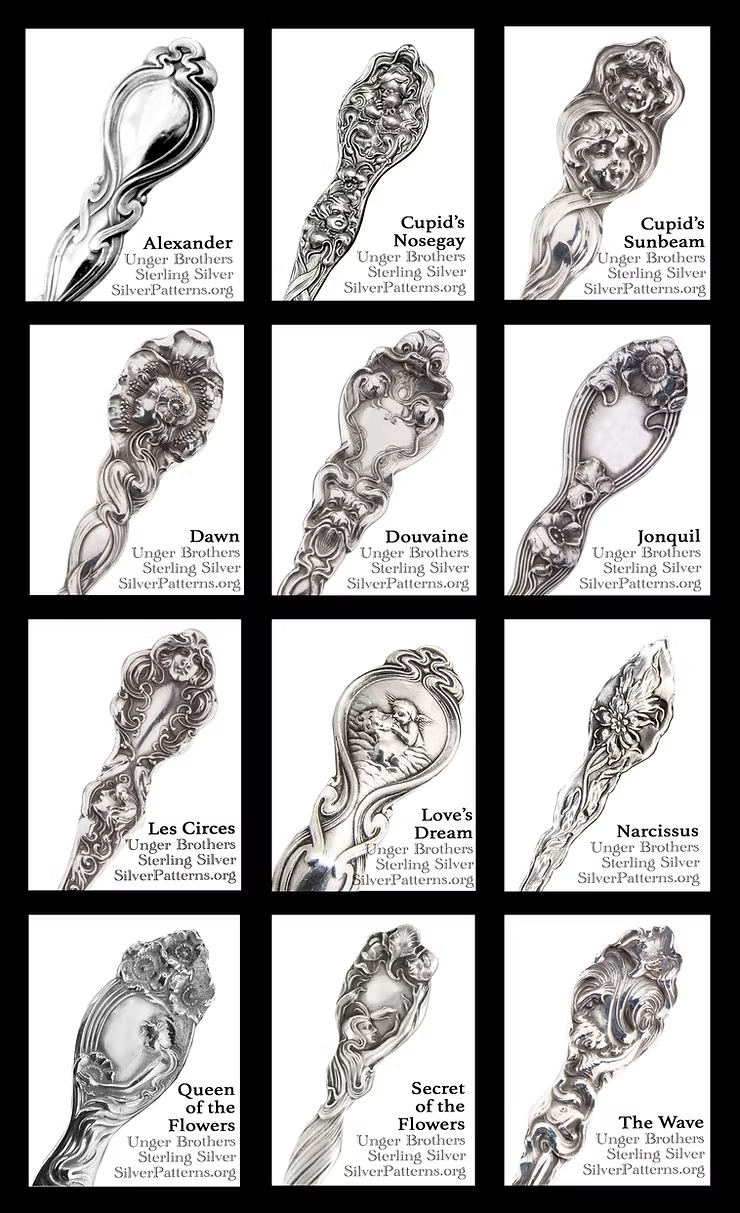
He trembled when he held hallmarked, Tiffany & Co’s, 1880 Chrysanthemum, Unger’s 1904 Evangeline and Reed / Barton’s ‘Love Disarmed’ 5 o’clock teaspoons. He discovered spoons of high value in the antique cutlery market, but never equaled: A 1690 William and Mary Provincial Silver. A Lace-Back Trefid spoon from Edinburgh priced at $17,727. A price at this level caused his heart to flutter at its magnificence.
Stanley planned to expand and meet the demands of the wider market. Pickle spoons were his favorite. He used the delicate, filigreed finish on their handles to fashion exquisite, dangle-style earrings. He could make ten sets of pickle spoon earrings in a day if he could get the spoons.
‘Life is good, everything’s near perfect.’
In his workshop spoon-fantasy world, he could hear the ‘bone-China ping’ as the bouillon spoon glanced the bottom of a tureen or soup bowl. He heard the ‘tink-de-da-tink-de-tink’ of a five o’clock teaspoon stirring an English China tea cup. The spoon’s ‘ting’ on pulverized bone connected him to past lives. His feelings numbed by human interaction didn’t stop him feeling the smooth, resting connection between the spoon and its fine linen tablecloth.
Earrings needed extra attention and demanded a light touch from his rough but not calloused hands. A Moto-tool smoothed rough edges and a final brisk, flattening tap on each end of the bracelet to hold the wrist were Touché touches brought to an end the afternoon or morning’s work. In the velvet lined wooden display box he added as a final touch a hand-printed a price tag with a brief history of the piece and a ‘Handcrafted by Stanley’ signatory
“Silver, (the care guide explained) is dark tarnished by sulfur-containing materials. Avoid contact with wool, felt, eggs, onions, rubber bands and latex gloves.”
These were never found in his mother’s house; a home with a free basement apartment and a garage workshop for his exclusive use.
For smaller pieces, he cleaned them of human oils, and used a black salt, hot water bath to reestablish the lightly tarnished look. After a two-minute swirl and soak, he removed, rinsed and light buffed his art pieces to preserve their precious and highly appreciated ‘patina’ (finish).
He took care to protect and preserve the spoons unique ‘glow’. Patina represented the luster of a full life in use. He held in reverence the prized shimmer of a fine patina.
Humidity speeds up the tarnish, so a dehumidifier hummed in the corner of his shop. He whistled and tapped, hack sawed and polished, bending and reflecting on his creation. Spoons were Stanley’s total life and except for Jennie, his mother, Buttercup, and his friend Everett, he was alone.
Stanley’s life mission: Create fresh life into art designed to the new use intended. He wanted the work to be perfect and his life mirrored his work.
He didn’t sell to chain stores or on-line; they would lock him into low price, piece work that would kill an ordinary person in a garage in an ordinary town. The way he worked was under his complete care and absolute control.
“Not much money, but whatever I make’s mine.”
‘My work embraces me totally; I lose track of time and if it wasn’t for the clock, I wouldn’t know it was suppertime. To find a client for an exclusive order, is pure joy. Plus, I can be here when mother needs me.’
Stanley hacked and tapped away in his garage morning, noon and night. The Christmas season made his routine daily pace hold greater intensity for higher value.
‘With a few sales I can make ends meet, enough to take Jennie out for a meal or to a movie. My feelings of love for her are growing stronger, and I want now, more than ever to be with her always.’
After his mother died, he spent time in antique shops in small towns looking for the unique, perfect spoon for Jennie’s engagement gift. One hallmarked or ‘maker marked’ by the best in the trade, crafted of the finest silver and chased with hearts, harps, ivy and tumbling flowers. A spoon edged with doves carrying sprigs of grass from which they will make a nest their home. This would be the special one to offer her in his proposal of marriage. Jennie took his heart and thoughts to a higher, more ethereal place,
“The perfect spoon will become Jennie’s engagement gift and make our dreams come true.”
Stanley’s dog-eared catalogues of the famous makers and hallmarks were searched for the ideal piece. He read them as a can’t put-it-down novel; the world disappeared when he opened the book’s covers.
He traveled and searched, asked and inquired, but never found the perfect spoon. He never crafted the engagement ring and bracelet set with “Handcrafted for Jennie, by Stanley,” written on a special card he reserved for the occasion. The piece would bind the spirit of his work to his love for her hand, her wrist, her heart.
Stanley found spoons close to perfection, but it was never the ‘one’. She waited him to ask her to marry and would have said yes in a heartbeat; but he wanted his engagement gift to be as perfect and uncomplicated as his love for her. He never found the perfect spoon as the undying symbol of his commitment to their life together. She waited his marriage proposal, but he couldn’t settle on the perfect engagement spoon. It was impossible for him to use less than perfection for this most important person and biggest event in his entire life.
Waiting his proposal, Jennie’s patience wore thin and when asked by another loving, kind man to be his wife, she went to him in her beckoning future.
Stanley gave up the golden dream of resplendent, shining love with a woman who loved him as he did her, to satisfy his greater need: The fixed order, dull luster of a life in patina.
After she married, he felt disappointed but realized he liked life as it was―symmetrical, in order, each day exact, aligned, like spoons nestled one into the next. He found peace and contentment with perfect companions for his metronome existence; Buttercup’s ‘milk’, his friend, Everett, and the velvet clock brushing the blush of time.