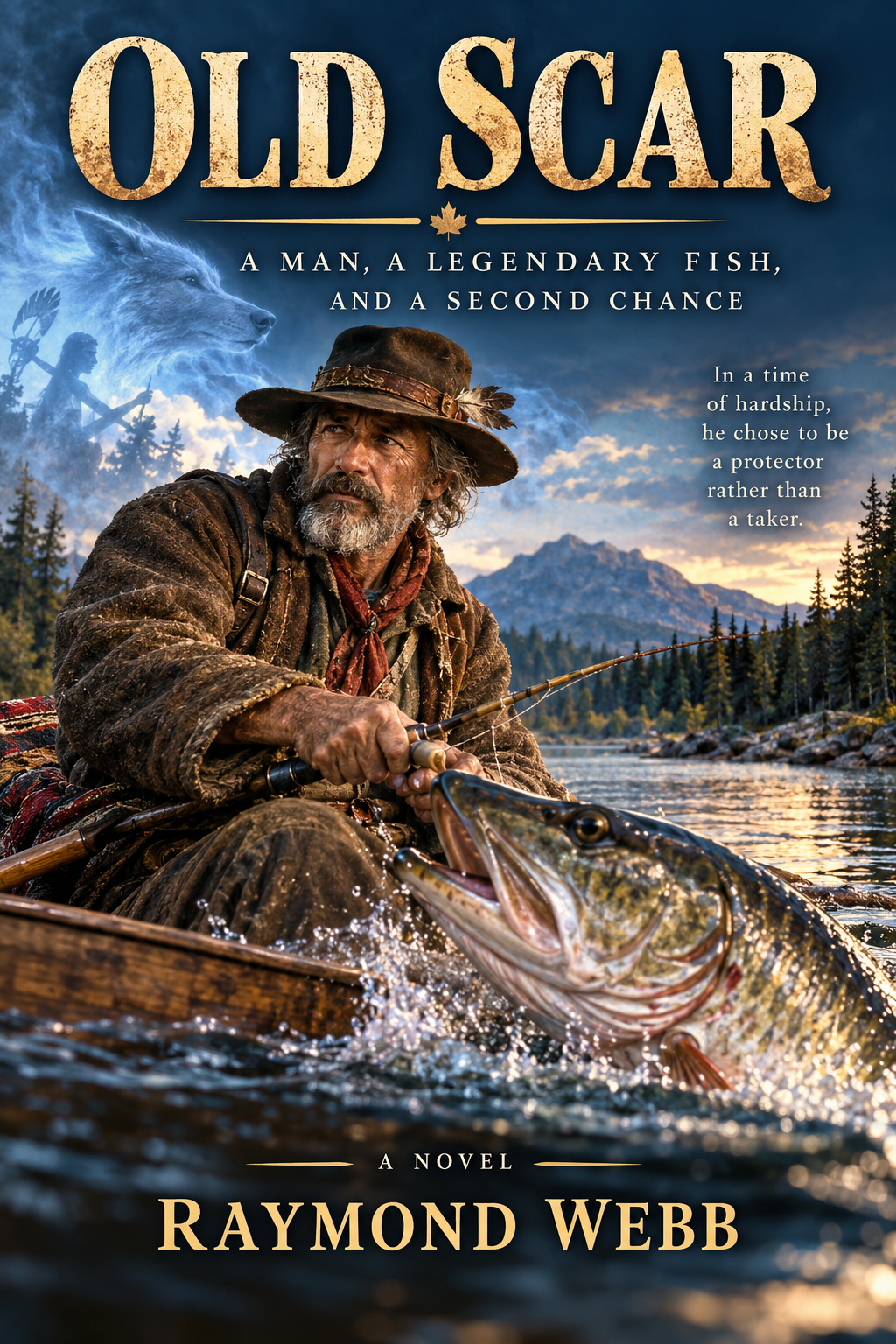
A novella
Old Scar
Raymond Webb
A man, a legendary fish, and a second chance.
Raymond Webb
Longer than a short story, shorter than a novel — a single life, held up to the light.
A novella
Raymond Webb
A man, a legendary fish, and a second chance.
Chapter One
“At daybreak their grand Sagamore (Chkoudun) came out of his lodge, going around about all the other lodges, and crying with a loud voice . . .to break camp and go to Tadoussac [eight days journey . . . wherein he embarked his wife and children, and a quantity of furs; and in like manner were launched well-nigh two hundred canoes.” McFeat, Tom, 1989. Rise and Fall of the Big Men of the Northeast: Maliseet Transformations, University of Toronto Press.
Whispering smoke dances off licking flames, the campfire burns low; embers covered by white ash, glowing. Jake squats on his haunches to savour his last bannock, salt-back bacon and beans breakfast, washed down with a steaming cup of billy-made tea. Enough to get him home, but not to restore his faith in his dream: What’s due to honest, hard-working man will have its day.
Frying pan bacon grease spurts into the coals, burning blue and orange without smoke. The dying fire’s ashes lifted by a light breeze dusted his trail-worn moccasin bottomed leggings. L.L. Bean made boots for the northeastern bush for men like Jake, if you could afford them. He couldn’t. Indigenous, smoked moose hide footwear the best for a man with no money for better. Smoked hide held the moccasins softness even after soaking. Wrapped high on his legs with rawhide ties circling, wool socks kept his feet warm and against chill, cozy. No rubber or leather soles for him, feeling the ground with each step connects his life spirit to Mother Earth. Surviving the hardship of a northern forest life is bred through blood and grown in bone.
He ate in silence. Failures like that; it goes inside and lingers, biding time for the promise to come. Believing in something isn’t enough to grant it success: Planning, persistence, luck and spiritual awakening all have roles bringing aspirations to fruition. Going home ‘skunked’ was a hard lesson to bear; he never thought he’d fail, this was the woods, his life. His hopes to change his life turned into ashes drifting the wind.
He muttered, “a few days, all I figured it’d take. It was a crazy idea anyway, there ain’t a camera built to record big plans with zero results.” No one there to hear his voice, he crouched, alone, on a Shield stone outcrop jutting into the misting lake. Bereft in spirit, worn thin from a week’s lost effort, he was at his lowest ebb. His grit couldn’t grind his gumption into something real, no matter how much he wanted it to be true.
Jake’s plan was simple, to offset his failing legs, trapping days done: Catch a big fish and have his picture taken to advertise fishing guide services for hire.
“Some idea that was, it sounded good at the time. but empty hands and a long face will tell the tale, I won’t need to say a thing. I figured a man born and raised in the bush could show he knew how and where, to catch a big fish, but after a week and no trophy to show, I’m done. Old Scar ate them all and what she didn’t eat are too damn nervous to come near this water again. My trapping skills might trade for a dollar but my fishing skills won’t trade for a bag of beans.” He did lot of his thinking by talking out loud, hearing it made it real.
“My journal’s open and I got nothing to write. How I caught the fish, where I fished; the firs fallen in the river, roots holding shore, the pulsing water’s flow under a log, the bite, the battle, the win. A shore lunch sizzling in the pan. My journals and the books I read don’t mount to much in the big world, but to me, they’re important, maybe someday, someone will read my story like it was. That’d be good to know.”
It was time to call his big idea quits, at least for now. In the 1940s an outdoors man of the Northeast in later age had two choices: keep working in the bush and die ‘in the traces,’ or, do something they always wanted to do - in his case, become a fishing and hunting guide in his home woods.
“I’ll give ‘er another shot next fall before winter sets in, when the fish are big and extra hungry. I ain’t a quitter, but got to finish this try for now; getting my ass kicked at this fishing thing doesn’t feel good, not one damn bit.
“A man’s known by how he survives. If we sweep floors or darn socks, we’re failures. What I know for sure is, anyone working the bush to make a living better be built tough, have a hard-set mind, good legs and a strong back or he’ll never make the pull. His thought went internal,
‘In middle age, women are luckier; they reset their bearings. If they’ve a mind to try something new, they do. Leave the old self behind, let her go. No regrets. That’s the ticket. They can change from the wild and crazy person they were before to a new, balanced one. Her kid’s grandkids take on a new meaning after that reckoning time of her life.
‘Men, heck we, don’t get the same shot: A clean start at a second life in later age. We’re fixed by what we do for a livin’ and we do it ‘til we die.’
Jake accepted the truth; his plan to catch a big fish, become a fishing and outdoors guide and leave the trapping life wasn’t worth a plug nickel. To provide for his family as a wilderness guide and give up trapping was a complete bust and a hard truth to ignore.
“You can’t earn top dollar as a guide if you can’t bring a fish home for dinner.”
Fifty years before in these same woods, the President of the United States, Ulysses Grant who led the Union Army to victory arrived to drive the last spike on the rail line between Vanceboro, Maine and McAdam, New Brunswick. This area is the famous woods all Americans know, its L.L. Bean Maine country and the Canadian side Jake calls home.
To take a break from the Great Depression and war years, sportsmen from the northeastern states came to the Canadian side through the middle-of-nowhere, Maine woods, into more middle-of-nowhere woods in McAdam, in New Brunswick. Jake was in the right place and the right time for his future fishing guide plan but not, if he blanked out on the angler’s tricks and skills needed to catch fish. Dynamite and gill nets are not the skills sportsmen are interested to hire for their vacation.
Back in the old rail days, everyone from the north-eastern states who loved fishing and hunting, heard about the virgin forests of Maine and New Brunswick. They paid big money to camp and fish in the untouched Canadian wilderness; the pristine home of trophy, white-tailed deer, moose and remote, unfished lakes and rivers. A good northern woodsman guide could make their Canadian bush dreams come true.
Without a fish to show, or business skills to offer, Jake’s efforts didn’t look promising. The life he knew, and the only home he’d ever known, was the forest and waters of the Canadian Maritimes. A place where a tourist advertisement for running water meant water flowing in a creek running nearby, and superb, wild game dining came from a hunter’s good shooting; if he missed his target, he didn’t eat supper. No restaurants need apply.
The plans of humans and nature rarely coincide. Humans are the only animal who destroy the natural world for their own benefit, rather than living in harmony with her. Many indigenous are seduced by the white man’s ways and have forgotten the sacred element of their ancestors: To be ‘one’ with the animals of the forest and to feel the spirit of the wilderness: You live in it, it lives in you. Without early conservationists like Jake who seeing the damage done by their handiwork expressed their hearts by respecting and conserving, not destroying, the natural world for financial gain.
Without early conservationists who expressed fears of ‘natural wonder’ and species loss to people in political power, North America would not have national parks; they’d be stripped clean of financial value until there was nothing left. A wasteland in the making is not pleasant to witness for the believer in natural balance and beauty. Jake became a believer. After stripping his pound of flesh from the bones of forest life, a supernatural blessing that would change his life to bring him back to his ancestor’s understanding of the natural world.
Jake communicated with Kji-Niskam the Great Spirit of his people and showed respect for the Earth before it was fashionable by white man to do so. He followed the indigenous ways of his ancestors and took only what he needed to survive. Different from his French speaking, Irish heritage father, Emile who had no regard for conservation and stripped the forest clean. This eco-thinking set Jake apart from other trappers who trapped wild animals for money and killed more than they needed to live.
Fishing guides are different from ornery, itinerant, solitary trappers. They share respect for the wilderness and their love of nature with fellow outdoorsmen. Stoic, principled men, like Jake, who witnessed first-hand, the damage caused by destroying natural resources for capital gain, from this realization these early protectors became pioneers of the ‘respect the environment’ movement.
In the 1930s and into the 40s war years, survival was a challenge for city and country people alike. Hunger, no work in the cities and failed farmlands reached deep into the society and touched, but didn’t penetrate, the remote forests of eastern Canada, a place apart from the American, dust bowl and war time rations economic disaster.
Adventurous sportsmen (mostly doctors) trekked into the Canadian wilderness to escape the doom of the Great Depression and its negative effect on their mental well-being. In this time of great social upheaval, visiting outdoorsmen gaining respite from the storm were made whole again by the wilds and wilderness guides. Jake loved working with kind-hearted clients, sharing nature’s energy and secrets with human camaraderie around campfires and tramping the woods looking for adventure.
There is no mark on eternity to show where we enter or when we leave. A hard scrabble life couldn’t bring a poor, unknown trapper from anonymity to fame, or failure to success. But that one, good fish that could change his life would be put on hold until next fall. He had one last winter trapping season in the bush before he had to call it quits.
For Jake, to catch fish with a fishing license, a steel pole, cotton fishing line and cranky reel (to keep matters sporting) would take more than a woodsman’s skill. If he wanted to catch a monster, 600 spiked-tooth muskie like Old Scar, he’d need a lucky break and luck, was never his favour.
Old Scar, a shape-shifter in his mind the devil muskie queen was his just due. If it didn’t catch, he’d accept the natural ending of his life as a wild animal; it lays down to die and without fanfare joins the spirit world, unremarked and forgotten. Sadness is not in nature; it’s intelligent animals who know pain and experience death that feel sadness from loss. And, yes, there will be sadness from his children when his spirit joins the wind.
“Humans have lost their way; living in harmony with Nature is the true way of life.” Jake North JN