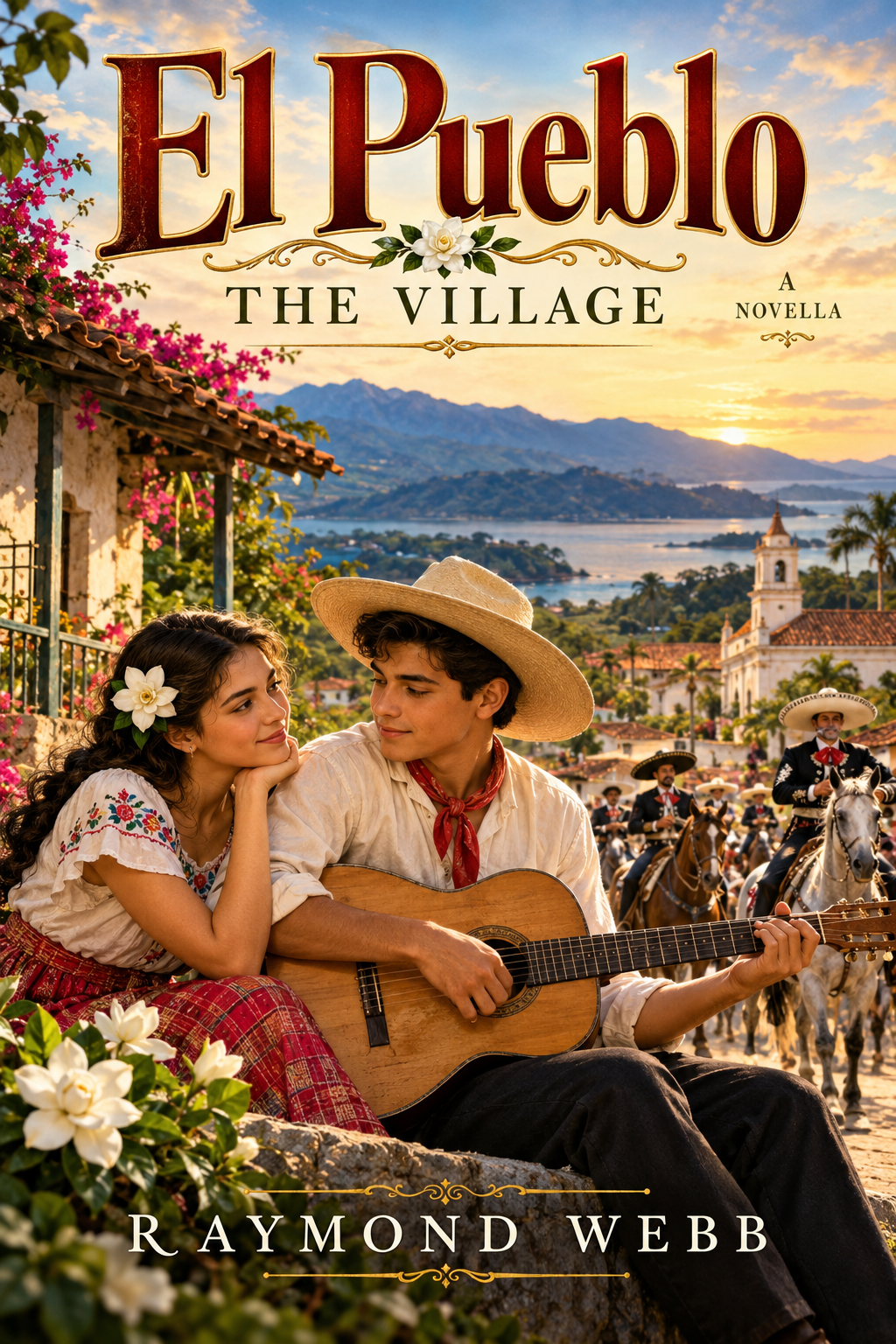
Carmen projected her best singing voice into the concrete pila wash-sink standing behind her humble mountain home. Singing, her celebration of a simple life. The traditional song, Celito Lindo filled her heart with a child's low-volume delivery. She felt the song was about her, as it sings of a dark-eyed beautiful woman with a beauty mark on her face that will be claimed by her husband, her true and forever love.
Her melodic voice, in perfect pitch, joined the running water's rhythmic flow. The sudsy soap, used in every home for cold-water washing, covered her flip-flopping hands in the wash tub sink. She accepted, as all poor children do, her role in the family's care; they have no choice, it's their life.
Carmen loved to sing as her name means song and poetry and exemplifies a purposeful, passionate woman. The previous generations of women in her country had non-existent identities and couldn't vote until 1950, so Carmen took great pride in her name; it was her grandmother's name and knowing this made her feel strong.
As a poor country girl, housework, caring for children and family is something she will always do. She doesn't resent her family role, as modern society's emancipated girls today might do; it was her small contribution to family upkeep, and she wanted to do it well. In Hispanic culture, housework, caring for siblings and one day, having her own family to love gives the women of poverty the chance for a full life. But this romantic sentiment takes second place to survive hardship. Men too, back-in-the-day, held traditional family roles, as father, husband, protector and provider. Where money is almost nonexistent in rural life, a family and a God guided life are treasures that make it precious. When what you have is all there is, and there is no more, joy must come from of simple pleasures.
The hardworking husband/father and wife/mother are the oxen pulling life's wagon team. Equal to the bueyes (mountain oxen) their heavy work load is shouldered without complaint. Parents, yoked-for-life, raised to the task by their parents before them.
In remote country hamlets even to this day a woman spends her time nurturing and caring for those she loves; her life centered on family is anchored by the love of God. Carmen was happy to have a part in her family's maintenance and delighted when her mother said “You've done you job well.” No-one would save her from the destiny of the poor, living at subsistence level, hardship all they will ever know.
The poor live simple lives by necessity, their only options toward survival are love for God and family. The world of material things is not their world; it's the consumer world of which they're not part. If you visit, you'll see, they're not saddened by their situation; they're cheerful, positive living people: Of no use to whine and complain over things you cannot have or a life you can't change. Public health care is free, and hunger is the central, unresolved issue for the poor. Poverty is a reality for thirty percent of the population, even today, and more so in earlier times, so making the best of what they have is how they learn to live their lives. Their consolation; accept what God has given you to build your life and with this, find someone to love, have a family and pray for a Christian life under His mercy.
In the 1950s, Central American rural families didn't have modern entertainment of television and record players in their homes. Their entertainment came from radios, religious festivals, birthday and marriage celebrations and annual fiestas featuring live musical performances.
Predawn darkness is tortilla making and coffee brewing time. The 4:00 AM radio program, Ranchera on Radio Sinfonola opens eyes and exchanges yawns for country music in every mountain pueblo home. Ranchera mariachis and singers steady paced Carmen's labor as the sun rose from behind the mountain above her humble home.
She sang to power her young girl hands to scrub, rinse and wring clothes to dampness. When finished her pila chore, she laid it out to whiten and dry on the barb-wire fence and bush edging their tiny plot of land. Warm air and sunshine gave the laundry outdoor freshness when folded to make it ready for her mother's clean inspection.
Carmen, born on yesterday's clock was expected to do chores, attend a brief education, find a good man to marry and raise her own family. There is peace in simplicity fortified by the love of God. Farmers, ranchers and big water fishermen living off the nature's benediction are fed by the soil and bountiful sea. They spend their entire lives in remote, rural pueblos and hidden mountain homes seldom vising the city, they're unknown and untouched by the outside world.
Carmen's mother and grandmother before her loved to sing and, as some daughters do, she followed her mother's lead. She sang to strengthen the tenuous hold on her life in its flow to a pre-determined future. It was in her heart to sing and her beautiful, bell-clear voice with pitch perfect ear were her gift from God. Her resonant, contralto-mezzo voice came from the purity of her heart and revealed the truth shining there. From her experience, Carmen's mother best expressed the value of singing to her daughter: 'El que canta sus males espanta.' One who sings frightens their worries away.
Her father, Manuel, was a lean, bronzed, weathered-skin fisherman. He loved to sing and sang to pass the long hours from dusk to dawn tending his long-lines in the reef-lipped bay. The red snapper pargo rojo and corvina sea bass he caught earned a cash income for the family's basic needs. The fish, abundant fruit trees, chayote vines, frijoles beans, elote corn and a pecking flock of hungry hens gave them enough sustenance to make a healthy life. Manuel and Angelina, Carmen's mother, came from the 'old school'; a school where shoes were a luxury, food in short supply and children in abundance didn't whine for something they could never have.
With the help of her parent's sculpting hands the family had food, shelter, and clothing for their children. In a land where shoes aren't needed and warm clothes unnecessary, clothing is a function, not a fashion fair. Poverty is endured with faith in a higher power and contentment with simplicity. Si Dios quiere, 'if God wishes' means people don't regret what does not come to pass.
Together, with her six sisters, Carmen helped her mother wash clothes, clean and care for the younger children, gather wood for the home fire and tend their garden and chickens. Her eight brothers worked as laborers (peons) on surrounding farms, as sabanero cattle cowboys and clearing land to keep their mountain home fires burning. Everyone worked the coffee harvest as this brought money and coffee to their lives. The poor do not hold great expectations or harbor unachievable dreams; they lead peaceful lives, unobstructed or complicated by the world outside their village.
To pass the star-filled nights in his panga boat alone on the ocean bay, Carmen's father sang in harmony with God's gift, the sea. He sang of hope that God ease his toil and found peace in the reverence of his clear, tenor voice in the night's salt air.
In the conch shell rose and pastel gray opening morning sky, Carmen walked to the wave lapping seashore to meet her father after his night with the ocean, fish and the stars. He floated in on the washing wave's foam and, as his boat brushed onto the sandy shore, he saw his barefoot daughter in her faded print dress, waiting to greet him. With the push of onrushing breakers and the drop of an outgoing tide he nudged his panga up and onto the shore. It would rest there and dry in the sun until the rising, evening tide lifted him and it to buoy the water and fish again.
He called out, “Carmen, mi bonitita, mi preciosa!” and his heart filled with gladness. She called with glee above the sonorous crashing waves, “Hola Papi!”
“Are you hungry? Look Papito, see what I've made for you, your favorite; gallititos, with cheese to make you strong.”
Carmen opened the towel tied at the top, to reveal, made by her hand, a morning food treasure. He ate with gusto, “Your food fills my belly and you, fill my heart Tita, God Bless our daily bread.”
Carmen took great pride in her gallos. Gallos, are a Costa Rican tortilla wrapped, hand-held food made using a metate (concave, stone grinding platform) to mash the lime adjusted corn to a fine pulp. Molded and flattened by hand into tortillas both sides are toasted-on-a-comal (a flat iron sheet over an open flame). A wrapped gallo can hold a piece of white, local 'Turrialba' cheese, a measure of re-fried beans or a dollop of other food to be eaten by hand. Her tortillas patted into round shape by her little girl's hands were smaller than normal and the ridges of her fingers showed on every toasted one.
Ticos, as the Costa Rican people are known, are named for putting the diminutives 'ito', and 'ita' to the ending of their words. Carmen's gallos, called gallititos were smaller but just as tempting and tasty. Following this naming custom, young boys and girls are not called by their actual names even by parents, but by the masculine and feminine diminutives of 'tito' for boys and 'tita' for girls. Children respond to anyone who calls them tito or tita as though they were their parents or family. In this way, the love and care of a child is extended to a wide circle of children by any loving, cautioning adults in their near vicinity.
“Did you make these for me, mi chiquita, Carmenita? Here, eat with me, we will share. These are the best gallos in all of Costa Rica, Tita,” as he spoke, he reached down, picked her off the sand and tossed her high into the air. She giggled in delight as he caught her in his warm salty hug.
“Let's go home my angel and give Mother a fresh fish for supper.” He took her small, light calloused hand in his rough, fisherman's palm and they walked into the symphony of a new day. Roosters crowed their challenge to the sun, dogs barked at invisible enemies and flocks of squawking green parrots flitted across the sky. The scene framed in sound by the… pop… pop chop of a woodsman's distant machete.
“Sing me a song Tita, mi chiquita. I love your sweet voice after the night's quiet-whisper air.”
Carmen knew many songs from the radio and some, she made up to entertain the dog at home. The children's song, Patito Juan was one of her favorites. It had a catchy beat and a Christian message for children about Juan, the bare-foot, baby duck who must learn to obey his mother and father. As she walked on her bare, pitter-patter feet, the tick-tock rhythm of Patito Juan added to the morning air. Carmen was honored to hold her father's fisherman's calloused hand and felt his strength coursing through her. For a child, to be loved by their parents is the greatest comfort feeling of their lives